Showing posts with label the Roman Republic. Show all posts

Monday, 16 January 2012

January 16: Beginning of the Roman Empire (27 BC)

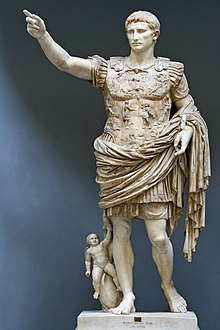
Gaius Julius Caesar Octavianus is granted the honorific title Augustus (the revered one) by the Roman Senate and became the first emperor of the Roman Empire on January 16, 27 BC. Augustus reigned the Roman Empire until his death on August 19, AD 14 for 40 years and 215 days. Born Gaius Octavianus Thurinus, he was posthumously adopted by his great-uncle Gaius Julius Caesar via his last will and testament in 44 BC and was officially called Gaius Julius Caesar. The official title as the Emperor was Gaius Julius Caesar Augustus. After the assassination of Julius Caesar, Octavianus formed a military dictatorship, known as the Second Triumvirate, with Marcus Antonius and Marcus Aemilius Lepidus and then defeated the the two: Lepidus was driven into exile and Antonius committed suicide after the defeat at the Battle of Actium by Agrippa in 31 BC. Octavianus then restore the appearance of the Roman Republic and spent four years to determine the framework by which a formally republican state can be ruled by a sole ruler, which resulted in the Roman Empire.  

Tuesday, 10 January 2012

January 10: Julius Caesar crossed the Rubicon (49 BC)

Gaius Julius Caesar
Gaius Julius Caesar and only one legion crossed the Rubicon river on January 10, 49 BC and ignite the civil war, which was the beginning of accomplishing Caesar vision of the transformation of the Roman Republic into the Roman Empire. At the time, Caesar was supposed to have quoted the Athenian playwright Menander, "alea icta esto" (let the die be cast), however, more commonly known quote of him at the time was "alea iacta est" (the die has been cast).  After crossing the river, Caesar defeated rivals and became the unrivaled leader of the Roman world. In 44 BC, a group of senators led by Marcus Brutus assassinated Julius Caesar on the Ides of March (March 15, 44 BC) with the hope of restring the government of the Republic. Octavianus, the heir of Caesar, eventually accomplished the vision of Julius Caesar and Octavianus became the first emperor of the Roman Empire. So the crossing of the Rubicon was really the point of no-return. 
Wednesday, 7 December 2011

December 7: Marcus Tullius Cicero was assassinated (43 BC)

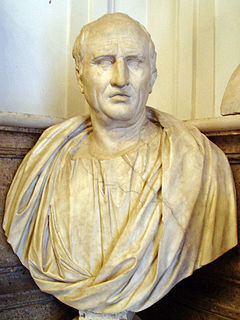
Marcus Tullius Cicero was a Roman philosopher, statesman, lawyer, and writer. Cicero was one of the greatest orators and writers. His letters and speeches are a primary source of Latin text. More than 800 letters of Cicero survived. In the Senate, Cicero championed a return to the republican government, which is against the idea of Gaius Julius Caesar who played a key role in the transformation of the Roman Republic to the Roman Empire. In 44 BC, Caesar was assassinated by the Liberatores, a group of people supporting the Senate and the Republic. Cicero became a popular leader of the republicans. Later, Octavius, Caesar's adopted son and heir, formed the Second Triumvirate with Marcus Lepidus and Marcus Antonius. Cicero was proscribed  as an enemy of the state by the Second Triumvirate and then killed in 43 BC.